Press Releases
Montgomery County Expands Food Recovery Network with New Funding, Coordination, and Community Partnerships
For Immediate Release: Tuesday, January 6, 2026
Montgomery County’s Office of Food Systems Resilience (OFSR) has announced the next phase of its Food Recovery Network strategy to expand coordination, infrastructure, and direct funding for community partners that rescue surplus food and redirect it to neighbors in need.
Food recovery, also known as food rescue, collects safe, unsellable food and redistributes it through community partners to reduce waste and address hunger. It supports County climate goals and helps feed the estimated 300,000 residents at risk of hunger. More than two dozen organizations recover and distribute surplus food, with food assistance partners serving over 106,000 residents each month. An estimated 35% of County residents experience some level of food insecurity.
Over the past 15 years, Montgomery County has invested more than $3 million in food recovery infrastructure, coordination, and community partnerships. Key milestones include:
- Establishment of the Food Recovery Work Group: Led by County Councilmember Valerie Ervin, this group was established in 2012 and brought together nonprofit providers, faith leaders, government agencies, and private sector partners to develop the nation’s first County-wide food recovery program.
- Strategic Partnerships: The County invested in contract partnerships with organizations such as:
- Nourish Now, to expand food rescue efforts and support the County’s service consolidation hubs.
- Community Food Rescue, operated by Manna Food Center, created a coordinated system and technology-based platform to recover and redistribute nutritious food across Montgomery County.
“Food recovery is one of the clearest examples of how we can reduce waste and help people at the same time,” said County Executive Marc Elrich. “When we created the Office of Food Systems Resilience, it was to build this kind of long-term capacity to connect partners, stretch every dollar, and make sure we are prepared to respond when federal or state resources tighten. This is resilience in action.”
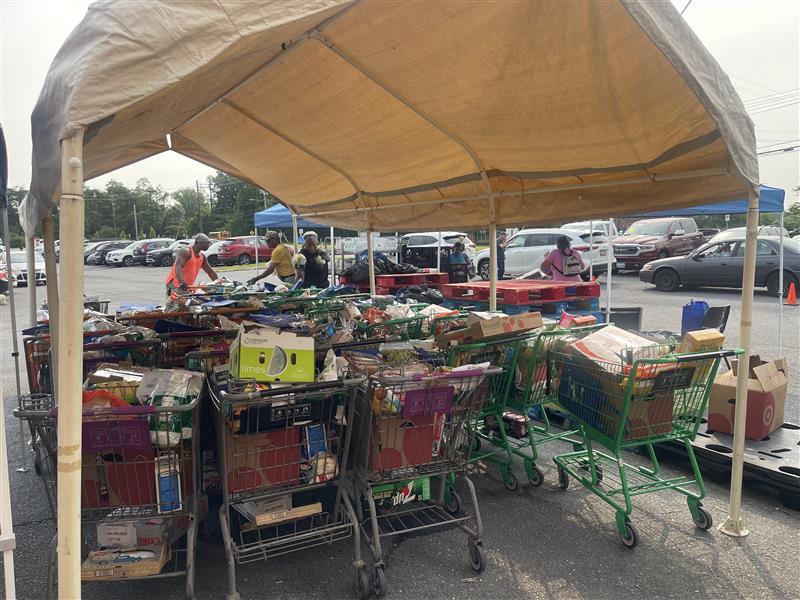
Three new OFSR grant programs collectively build a more resilient, efficient, and collaborative food recovery network:
- Infrastructure investments: The Food Recovery Network Infrastructure (FRNI) Grant Program awarded $306,000 in Spring 2025 in total to AfriThrive, Nourish Now, Rainbow Community Development Center, and So What Else to expand transportation and cold storage capacity across the County’s food recovery network. Funded projects include refrigerated vehicles and shared cold storage units that increase the network’s ability to recover, store, and distribute fresh, perishable foods. These investments strengthen the overall capacity of food recovery partners, improve access to nutritious food for residents, and strengthen community resilience in emergencies.
- Coordination and planning: The FY26 Food Recovery Network Coordination Grant just awarded $30,000 to the Montgomery County Food Council (MCFC) to strengthen partnerships across the County’s food system by convening food recovery organizations as the primary coordinating organization for the County’s Food Recovery Collaborative (FRC). The team will organize regular convenings of food recovery partners, facilitate data and resource sharing, and identify opportunities for collaboration and efficiency across programs that recover, store, and distribute rescued food.
Direct funding for recovery operations: Through the FY26 Community Food Assistance (CFA) Grant Program, in October 2025, OFSR awarded $428,202 to six organizations for food recovery services, including:
Of this amount, $290,785 is renewable FY26 CFA funding and $137,417 is supported through a FY26 Special Appropriation passed on Nov. 18. These awards strengthen partner capacity to recover, handle, and redistribute surplus food and expand access to nutritious foods for residents across the County. Collectively, these partners aim to recover and redistribute more than 10 million pounds of food annually. Together, these investments are improving network operational efficiency, reducing landfill waste, and ensuring that fresh, nutritious food reaches more residents.
To inform strategy development, OFSR conducted interviews and surveys with 18 food recovery partners, which confirmed that recovered food is a major source of fresh food for many food assistance organizations, often accounting for up to 90 percent of the food that they distribute.
The research also highlighted the breadth of the County’s donor network and recovery network. Partners reported receiving food from large supermarket chains, local grocery stores, ethnic markets, restaurants, bakeries, farm stands, and community events. Some received donations from warehouses outside the County. Many partners, especially those recovering smaller or urgent donations, relied on volunteers who picked up, sorted, and transported food using their own vehicles. While volunteers played an essential role, limited volunteer capacity and transportation constraints made it difficult to capture all available donations.
Partners described common challenges that limit the amount of food that can be recovered. Transportation and cold storage were identified as the greatest needs, along with the lack of dedicated drivers, inconsistent donor schedules, and the short shelf life of rescued food. Partners also noted difficulties coordinating across different platforms and processes, limited communication among organizations, and a need for more outreach and training for donors and volunteers.
This partner feedback directly shaped Montgomery County’s food recovery strategy, which focuses on investing in infrastructure, expanding direct support for food recovery operations, and establishing a central coordinating entity to strengthen collaboration and improve efficiency across a formally established network.
“Manna Food Center and the Community Food Rescue program laid the foundation for this work over the past decade,” said Heather Bruskin, director of OFSR. “We are proud to build on that legacy by cost-efficiently leveraging critical food resources at a time of growing community need, while also reducing the climate impacts of wasted food.”
Further strengthening the operational network’s capacity, partnerships, and communication will enable the local community to work more efficiently in day-to-day operations and respond more quickly during emergencies.
“Community Food Rescue (CFR), a network of over 400 donors, food providers, and volunteers, has rescued nearly 14 million pounds of food since its creation in 2012,” said Jenna Umbriac, director of Community Impact at Manna Food Center. “Manna could not have accomplished this without our partner organizations, and we are confident that the spirit of collective impact that built CFR will be continued in the program's next phase. Manna is committed to offering our support to MCFC as they take on the coordination of the vital activities that help Montgomery County feed more and waste less.”
By expanding and diversifying the donor network as well as donor engagement and retention, increased food supplies will be available for redistribution through the 50+ food assistance provider organizations that receive financial support through the County government.
The newly formed Collaborative, which includes all OFSR food recovery grantees as members, will meet bi-monthly to share resources and lessons learned and collaboratively problem solve around present challenges to develop shared solutions.
“The Montgomery County Food Council is excited to partner with the Office of Food Systems Resilience to launch the Food Recovery Collaborative, a space for food recovery organizations, food assistance providers, and food recovery experts to share best practices and strengthen coordination,” said Elizabeth Teuwen, co-executive director of the Montgomery County Food Council.
The Food Council will coordinate a network assessment of service area coverage and operational capacity, identify challenges and opportunities within the network, and provide ongoing technical assistance and training to members.
“This funding will strengthen our food recovery efforts and help us bring more fresh, nutritious food directly to families at the school sites that are most convenient for them. We deeply appreciate the opportunity to serve our community in places they already trust and rely on,” said Megan Joe, executive director of Hunger Relief at So What Else.
Additional grant recipients emphasized the impact these investments will have on improving access to nutritious food across the County.
For more information about the Food Recovery Collaborative and other OFSR and Montgomery County food systems initiatives, visit montgomerycountymd.gov/ofsr, or contact Heather Bruskin (heather.bruskin@montgomerycountymd.gov).
###
Media Contact: Catherine Nardi
Categories: Executive Office, Health