Press Releases
Rent Stabilization Law is Delivering Stable, Predictable Rent and Fee Increases and Improving Housing Conditions for Tenants
For Immediate Release: Thursday, February 19, 2026
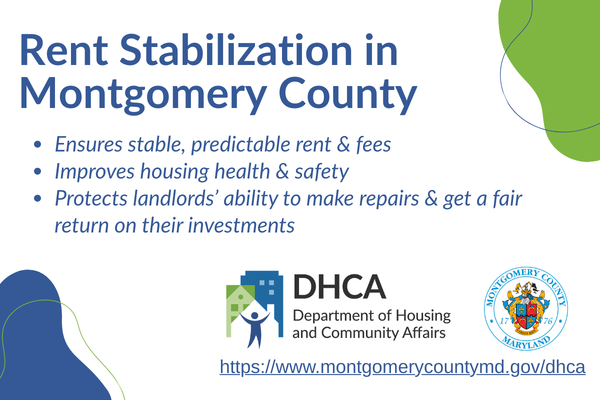
The Montgomery County Department of Housing and Community Affairs (DHCA) published its first report on the outcomes of the Rent Stabilization law, enacted in July 2023, which is delivering stable, predictable rent and fee increases and improving housing conditions. Greater stability and predictability allow households to better plan for the future and reduce the likelihood of tenants being displaced by large rent increases and poor housing conditions.
The Office of Rent Stabilization (ORS) report details how the County’s Rent Stabilization law has stopped significant rent increases while also protecting landlords’ ability to receive a fair return on their investments and make necessary repairs to their properties. The Rent Stabilization law particularly benefits households in lower-income areas of the County, communities of color, and seniors or tenants with disabilities living on fixed incomes.
“Montgomery County enacted our rent stabilization law to give many renters more stability by stopping excessive rent hikes and junk fees. The results after one and a half years show that the law is delivering on that promise,” said County Executive Marc Elrich. “The County carefully designed a fair law that protects tenants while allowing reasonable rent increases so that landlords can maintain safe and healthy properties.”
The Rent Stabilization Law (Bill 15-23) was enacted on July 18, 2023, and became effective on July 23, 2024, through Executive Regulation 2-24.
“When I took the responsibility of ensuring that Council would reach a compromise to pass the rent stabilization bill, I knew I was going to encounter lots of challenges, yet I didn’t hesitate,” said County Council President Natali Fani-González. “The bill was way too important for families facing stagnant wages and high costs of basic needs, including child care costs. As you can see from this report, families can predict their rent increases and hold properties with extensive housing code violations accountable, as they are restricted from raising rents until the violations are fixed. This is how you protect your workforce, ensuring they can afford to live in our County in healthy homes."
The law, which covers rental properties in the County more than 23 years old, was carefully designed to moderate year-over-year rent hikes. Landlords retain the ability to raise rents to match inflation levels plus 3% (capped at 6%); they also can request permission for limited increases above that rate to cover the costs of key capital improvements or to protect their financial investments. DHCA also regulates the types and amount of fees landlords can charge to tenants.
“The successful first year and a half of Rent Stabilization in Montgomery County is encouraging news for both tenants and landlords,” said DHCA Director Scott Bruton. “By stabilizing rent and fee increases, the law helps stop the kind of drastic price increases that displace tenants from their homes. By ensuring that landlords cannot circumvent the law by disguising rent increases as mandatory fees, it protects renters and enables landlords to compete for business in a fairer marketplace. The law is keeping costs manageable for many households, especially those in lower-income areas, communities of color, and seniors and people with disabilities living on fixed incomes.”
The ORS report highlights the following positive impacts of Rent Stabilization on renters and the housing market in the law’s first 18 months:
Refunds and Reductions in Proposed Rent and Fee Increases
- ORS secured more than $90,000 in rent and fee refunds for tenants: ORS responded to 1,390 inquiries by residents, predominantly from individual tenants seeking review of the rent or fee increases they have received or to discuss their rights under the Rent Stabilization law. These inquiries have resulted in a total of $91,759 in refunds to tenants, including:
-
- $68,516 in rent refunded to tenants across 195 units.
-
- $23,244 in fees refunded across 207 units.
In addition to the direct financial benefit of these refunds for affected tenants, successful enforcement acts as a deterrent, making it less likely a landlord will charge an illegal fee or impose illegal fee increases on tenants in the future.
- ORS enforced or negotiated an average 56% reduction in proposed annual rent increases per tenant: ORS enforces rent increase limits for rent-stabilized properties and offers to mediate landlord-tenant disputes related to rent increases and fees for properties exempt from rent stabilization. As a result of this enforcement and mediation, renters saw an average monthly reduction of:
-
- $445.82 for month-to-month leases (a savings of 82% compared to the proposed increase).
-
- $95.41 for one-year leases (a 56% savings).
-
- $141.14 for two-year leases (a 59% savings).
- Regulation of fees ensures landlords cannot circumvent rent increase limits by disguising rent increases as mandatory fees: The Rent Stabilization law and regulations give DHCA the authority to restrict the types and amounts of fees landlords can charge. This restriction ensures landlords cannot sidestep the law’s protections and disguise excessive rent increases as fees. In addition to the $23,244 in refunds secured, ORS has negotiated fee discounts averaging $22.28 per month, resulting in a 34% reduction in monthly fees.
Protecting Landlords’ Ability to Receive Fair Returns on Investments
- DHCA has approved appropriate Fair Return and Capital Improvement petitions submitted by landlords, ensuring they can maintain their investments. During the time period covered by the report, DHCA:
-
- Received and approved all three Fair Return petitions it received, which are based on the landlord demonstrating that increased rent is necessary to offset operating expenses and is comparable to the returns on similar investments.
-
- Approved all three Capital Improvement petitions it received, which help landlords cover substantial improvements above and beyond ordinary repair and maintenance.
-
- Received one pending Substantial Renovation application, which allows a landlord to obtain a 23-year exemption if the cost of renovations equals at least 40% of the building’s assessed value.
Community Outreach and Service Requests
- ORS held 34 outreach events with 1,710 attendees, including both tenants and landlords: The virtual and in-person outreach events educated tenants, landlords, and the public and included partnerships with trusted community organizations to expand reach and build trust in underserved communities.
- ORS responded to 1,390 service requests: ORS resolved 97.99% of service requests within three business days, including 54 Spanish-language requests and one in Mandarin. Top topics for requests included rent increases (56.3%), fees (14.5%), and general questions (14.4%).
Improved Housing Code Enforcement Outcomes
- The rent stabilization law has led to fewer “Troubled” and “At-Risk” properties with extensive housing code violations: Under the rent stabilization law, properties with extensive housing code violations—i.e., those designated “Troubled” or “At-Risk” based on the severity of violations—are restricted from raising rents until the violations are fixed. Based on the FY25 Troubled Property Report, DHCA housing code inspectors found increased effort by landlords to correct violations, resulting in a 69% decrease in the total number of units in Troubled properties and a 57% decrease in the total number of units in At-Risk properties compared to the previous year.
Racial Equity and Economic and Social Justice Impacts
- Rent Stabilization particularly benefits lower-income areas, communities of color, and seniors.
-
- The Rent Stabilization law and Executive Regulation 2-24 are key tools for reducing housing instability and displacement, which disproportionately affect Black, Hispanic/Latino, immigrant, and low- and fixed-income households in the County and supporting the County’s vision of a more affordable and welcoming community for all.
-
- Collectively, this evidence demonstrates that the ORS’s enforcement of the Rent Stabilization law and regulation protects tenants from overcharges for rent and fees and fosters systemic improvements in housing conditions for the County’s most structurally disadvantaged residents.
In addition to detailing the financial impacts of Rent Stabilization, the ORS Annual Report describes steps DHCA has taken to implement the law, including establishing a new Housing Portal to facilitate landlord compliance with the law and regulation and to provide tenants with detailed information about the properties where they live or may be considering living.
County tenants and landlords who have questions or would like to file a complaint should call MC311 (240-777-0311). More information about the Rent Stabilization law and the ORS’s work is also available on DHCA’s website at https://www.montgomerycountymd.gov/DHCA/Tenants/RentStabilization.html.
Read the ORS Rent Stabilization report.
Watch the press conference on YouTube.
# # #
Media Contact: Matthew Cournoyer 240-338-5078
Link to Photos or Video: https://www.youtube.com/watch?v=t0WFgJzBhlw
Categories: Housing